
WHITE PAPER | Bridging the Facility Handoff Gap: Evaluating Developer-Led Asset Management in Higher Education Satellite Expansions
Executive Summary
As higher education institutions expand their footprints through satellite campuses and specialized regional facilities, the transition from construction completion to full operational occupancy represents a critical risk window. The first several years post-delivery present the highest exposure to technical system friction, warranty enforcement matters, and unmapped lifecycle cost variations.
For institutions opening facilities at a geographic distance from their primary campus operations, establishing an immediate, fully staffed, on-site facility management presence introduces logistical and operational challenges. For these new facilities, retaining the project developer under a temporary, 2- to 5-year post-delivery asset management framework provides an operational bridge.
This transitional model allows the university to leverage the institutional knowledge of the development, design, and construction team to absorb early operational friction, reconcile warranty matters, and establish predictive performance baselines while internal university facilities teams are incrementally onboarded and oriented to the new asset. From an administrative perspective, transitional period asset management contracts can be structured as options, extended warranties, or add-on services within the primary delivery period development agreement and executed via change orders.
The Post-Delivery Vulnerability Window in Academic Infrastructure
High-performance academic, research, and technical facilities inherently experience operational calibration periods following initial occupancy. Standard facility handoffs often encounter five primary structural vulnerabilities during this window:
- Geographic and Bandwidth Constraints: Establishing a remote facility distant from a primary campus creates immediate resource friction for main-campus facilities teams, who must balance remote operational demands against core campus priorities.
- Third-Party Operational Learning Curve: Transferring a complex, newly constructed facility to a standard operations contractor creates an immediate knowledge gap. Time and financial resources are frequently expended diagnosing complex Mechanical, Electrical, and Plumbing (MEP) and Building Management Systems (BMS) with which the operational team was not involved during installation.
- Occupant & Operational Disconnect: Facilities teams often focus strictly on physical building assets, leaving academic users, faculty, and students to navigate new space configurations without structured change management or occupancy support.
- Warranty Reconciliation Delays: Initial operational disruptions or equipment anomalies require rapid tracing through original subcontractor channels. Managing warranty reconciliations across multiple trades through standard facilities reporting can lead to extended response times and potential disruption to academic schedules.
- Lifecycle Cost Compounding & Capital Overhaul: Unmonitored early operational deviations from original design parameters can compound rapidly, creating premature maintenance backlogs. Furthermore, establishing dedicated on-site maintenance fleets immediately post-occupancy often forces premature capital expenditures on redundant tools and equipment.
Comparative Operational Models: Traditional Handoff vs. Developer-Led Asset Management
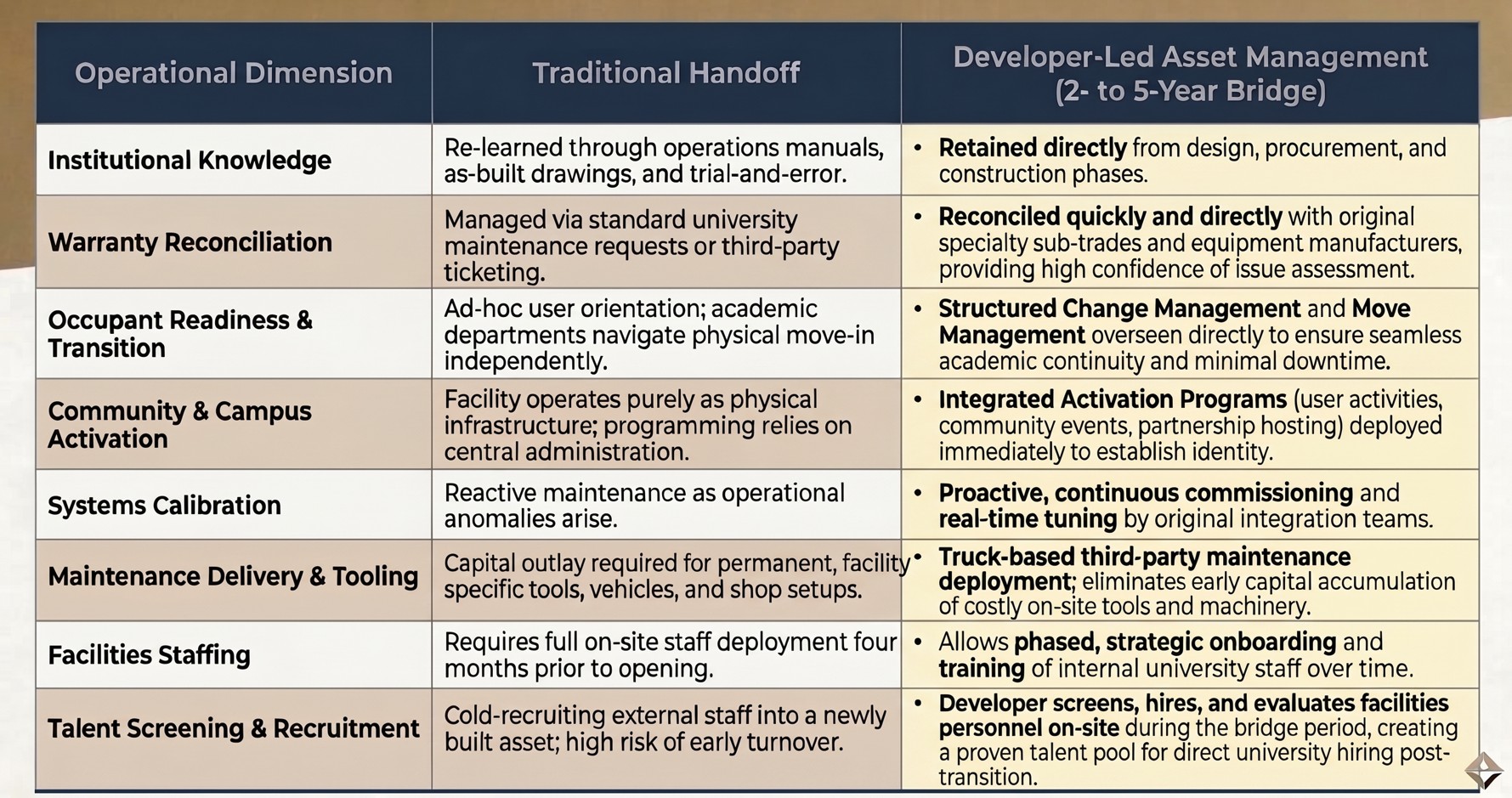
Core Strategic Benefits of the Developer-Led Asset Management Framework
- Design-Phase Operational Alignment: Establishing an operational role for the developer post-occupancy aligns incentives, ensuring long-term maintenance accessibility, energy performance, and user experience are prioritized early in the design process.
- Comprehensive Experience & Occupancy Oversight: Beyond building controls, expanding the transitional framework to cover physical move management and strategic change management mitigates the organizational stress experienced by faculty and staff relocating to a new satellite asset.
- Elimination of Multi-Party Friction: Traditional handoffs frequently suffer from diagnostic "finger-pointing" between delivery teams and incoming operations managers. A developer-led bridge ensures the team that understands why systems were designed in a specific manner remains accountable for verifying that they perform as intended.
- Lean Capital Maintenance Operations: Leveraging mobile, truck-based third-party specialty service teams during early years prevents the university from accumulating expensive specialized tools, diagnostic devices, and fleet inventory before operational scale justifies them.
- Risk-Mitigated Talent Acquisition (Staffing Screening Mechanism): Utilizing the developer during the transitional window provides a real-world testing ground for facilities personnel. The university avoids early hiring missteps by allowing the developer to recruit, train, and screen key facilities staff on the specific building systems, enabling the university to selectively offer permanent employment to high-performing, fully trained personnel when long-term stewardship transfers back to the institution.
- Streamlined Administrative Structuring: Contracting for transitional services as pre-negotiated add-on services or extended warranty extensions within the initial development agreement eliminates the administrative overhead of issuing separate, standalone operations procurements at facility opening.
Key Pillars of Strategic Asset Stabilization
- Total Cost of Ownership (TCO) & Facility Condition Index (FCI) Tracking
Utilizing predictive lifecycle cost models, the developer-led team benchmarks real-time building performance against the FCI:
FCI = Deferred Maintenance Cost / Current Replacement Value
- Change Management & User Transition Coaching
Facility handoffs succeed or fail based on user adoption. A specialized transitional team establishes a structured Change Management program that guides faculty, administrative staff, and researchers into the new environment. This includes developing user orientation guides, facilitating technology walk-throughs, establishing clear service-request protocols, and helping academic units adapt to new physical workflows.
- Professional Move Management Oversight
Relocating academic programs, specialized laboratories, and administrative offices presents substantial operational risk. The developer-led bridge takes on direct oversight of the moving process—coordinating specialized logistics vendors, establishing phased move schedules, managing loading dock access, and protecting newly finished building surfaces during move-in to ensure zero disruption to term start dates.
- Campus Activation & Community Programming
A satellite campus requires rapid cultural integration within its host municipality. The transitional management framework incorporates active user and community programming—facilitating ribbon-cuttings, regional stakeholder events, campus activation workshops, and public-private industry mixers that build immediate brand equity and public engagement for the university.
- Lean Maintenance Delivery via Mobile Specialist Teams
Rather than establishing full fixed-site maintenance shop setups with dedicated machinery and heavy equipment during low early-occupancy phases, the transitional model often utilizes truck-based, third-party specialist maintenance providers. These mobile units perform routine and preventive care on-demand, preventing the unnecessary buildup of costly on-site teams and specialized tools and capital equipment at the property while maintaining rigorous service level agreements.
- Transitional Talent Screening & Direct-Hire Workforce Pipeline
Acquiring high-caliber facilities staff who understand complex, modern satellite facilities is a major challenge for expanding institutions. Under the transitional model, the developer recruits, screens, and manages dedicated facilities personnel during the initial years of operations. This period acts as an extended evaluation and onboarding window. Personnel become intimately familiar with the building’s specific MEP systems, controls, and faculty needs while under developer supervision. When the university assumes full operational control, it can seamlessly transition these proven, pre-vetted professionals onto university payroll—eliminating recruitment lag, reducing hiring risk, and ensuring operational excellence.
- Direct Trade & Warranty Accountability
Because the development entity managed trade contracts during construction, warranty claims are addressed directly with the installing subcontractors, eliminating administrative burden on university procurement and facilities staff.
- Integrated Technology & BMS Optimization
Complex digital networks, smart-lighting arrays, and laboratory controls require continuous calibration post-occupancy. Direct oversight and remote monitoring by the original integration team minimizes network and control downtime and facilitates early detection of anomalies.
Case Scenarios: Post-Occupancy Problem Resolution
Scenario A: Complex Research Lab Airflow Imbalance
- Issue: Seasonal climate changes trigger pressure and airflow variances in specialized research spaces.
- Standard Operational Approach: Satellite facility staff must review complex as-builts, coordinate with remote main-campus engineers, and contact third-party service contractors, resulting in extended diagnosis timelines.
- Transitional Model Approach: The integrated asset team re-engages the original mechanical engineer and system controls contractor to recalibrate software settings immediately, leveraging original commissioning parameters.
Scenario B: Gray-Area Equipment Defect vs. User Error
- Issue: Advanced variable air volume (VAV) equipment experiences repeated sensor faults during Year 1; the manufacturer attributes the failure to operational misuse.
- Standard Operational Approach: The institution faces potential out-of-pocket costs for third-party inspection or replacement components to restore functionality.
- Transitional Model Approach: Utilizing original commissioning data logs, the asset management team verifies that operating conditions were within designed tolerances, compelling the manufacturer to repair the system under warranty.
Scenario C: Satellite Opening Phase-In & Logistics Bottleneck
- Issue: Multiple academic departments and third-party vendors attempt to occupy the satellite campus simultaneously two weeks prior to the fall semester start, causing dock congestion, elevator lockouts, and damage to fresh interior wall finishes.
- Standard Operational Approach: Satellite staff reactively attempt to manage traffic, resulting in delayed department setups, damaged property, and frustrated faculty.
- Transitional Model Approach: The developer-led team executes a comprehensive Move Management and Change Management plan—providing pre-move orientation with the new facilities, staggering delivery windows, deploying dedicated dock marshals, applying protective wall and floor coverings, and guiding departments through pre-assigned move corridors, resulting in on-time academic opening without facility damage.
Conclusion
The first several years of a new satellite campus set the foundation for institutional reputation, end-user experience, operational efficiency, and long-term asset value. Adopting a temporary, 2- to 5-year developer-led asset management structure offers higher education institutions a risk-mitigation framework during major expansions.
By expanding the transitional role to encompass change management, move management oversight, community activation, lean truck-based maintenance strategies, and a structured facilities talent screening pipeline, the institution achieves complete operational stabilization. This holistic bridge secures a fully tuned, predictable asset, protects early capital outlay, and establishes a pre-vetted, expert facilities team ready for direct university hire as internal university staff seamlessly assume long-term stewardship.

